
VICTORIAN ENGLAND AND SCOTLAND
(1840s–1880s)
Poverty, Vulnerability, and Social Realities
Imagine Westminster Abbey today and it’s spires and church majesty. And yet, Westminster included some of the most notorious slum districts in Victorian London during the Industrial Revolution. Contemporary observers knew it, and Charles Dickens drove the point home when he wrote about the area called Devil’s Acre, challenging the polished image of Westminster as only a landscape of palaces, grand squares, and royal terraces.
Victorian Britain projected confidence: industrial power, imperial reach, and visible respectability. Beneath that surface lay crowded housing, fragile incomes, and limited safeguards for those who fell ill, lost work, or slipped outside accepted norms. Scotland and England shared many of these patterns with local variations in law and church life. The world George MacDonald wrote into was not abstract; it was made of rooms, streets, fields, and institutions that shaped the lives of women, children, workers, and the poor.
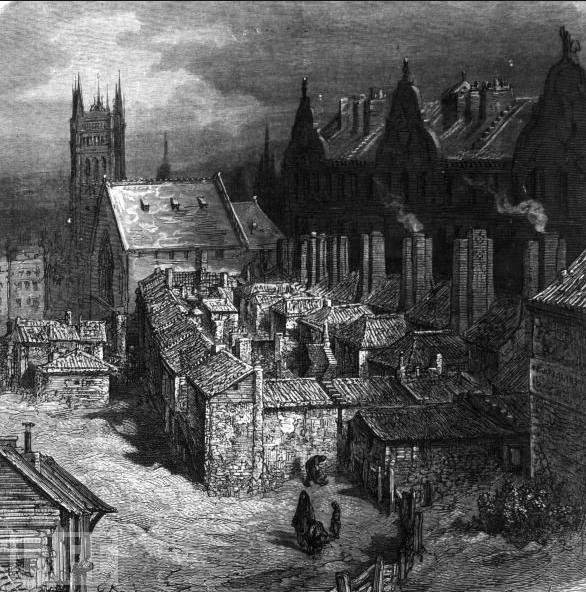
The “Devil’s Acre” as depicted by Gustave Doré in London: a Pilgrimage (1872)
-
Between the 1840s and 1880s, industrialization accelerated. Factories, mills, and shipyards drew people into towns and cities faster than housing and infrastructure could develop. In London, Glasgow, Manchester, and other centers, whole districts consisted of overcrowded tenements and courts. Families often lived several to a room; some lodged in damp cellars with little light or ventilation.[1] Open drains and rudimentary sewers polluted local rivers. Clean water, where it existed, came late and unevenly.
By the 1880s and 1890s, Charles Booth’s London surveys provided detailed maps of this urban poverty. He estimated that around 30 percent of Londoners lived in “poor” or “very poor” circumstances, including those in chronic want and those he described as “semi‑criminal.”[2] His work confirmed what earlier observers and residents already knew: large numbers of working people lived close to the edge, with intermittent employment and thin reserves.
Glasgow and other Scottish industrial towns showed similar patterns. Districts such as the Gorbals became synonymous with overcrowding and poor housing conditions, with reports of seven to nine persons per single room in some dwellings.[3] Industrial wages fluctuated, rents claimed a high proportion of income, and many workers relied on casual or seasonal jobs. A single accident, illness, or downturn could push a family rapidly toward destitution.
-
Women carried particular forms of vulnerability. In England and Wales, the legal doctrine of coverture meant that a married woman’s legal identity and property were largely absorbed into her husband’s. Before the Married Women’s Property Acts of 1870 and 1882, most married women had limited independent rights to own property or control earnings.[4] In Scotland, legal structures differed but still left husbands with extensive control over family resources. Desertion, financial abuse, or waste could leave wives and children with few options.
Work opportunities for working‑class women concentrated in domestic service, textile factories, laundry work, and home‑based piecework such as sewing. Wages were typically low, often significantly below men’s earnings for comparable hours.[5] Domestic service in private homes placed women in settings where labor exploitation and sexual harassment could occur without public scrutiny. Legal redress was difficult to pursue, especially for young servants far from family.
Social expectations around sexual purity, marriage, and motherhood intensified these material risks. Unmarried mothers and women labeled “fallen” faced strong stigma and limited routes to economic stability. Some women turned to street vending or prostitution when other work failed. The combination of weak legal standing, restricted job choices, wage inequality, and moral judgment produced a persistent pattern of economic and personal vulnerability.
-
Children formed a vital part of household economies. Many worked from an early age in factories, mines, farms, and domestic service. The Factory Acts (beginning in 1833 and extended later) restricted hours and set minimum ages in certain industries, but enforcement was patchy and did not cover all sectors.[6] In Scotland and England, mid‑nineteenth‑century census data suggest that a substantial proportion of boys and a notable share of girls aged ten to fourteen were in paid employment.[7]
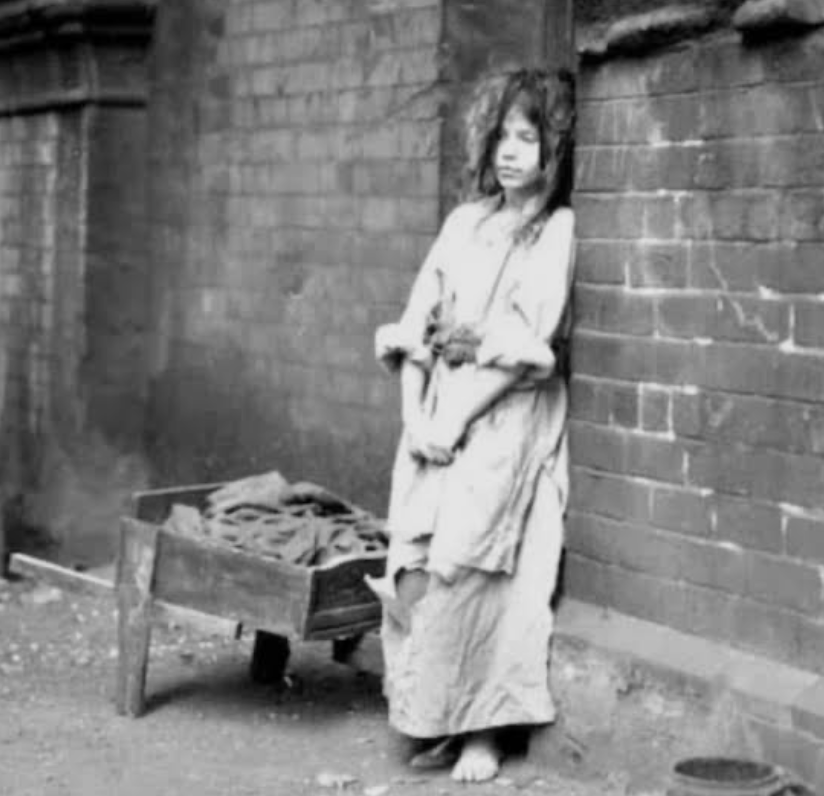
Urban streets contained their own child population: orphans, runaways, and children from families unable to provide stable housing. They survived through begging, petty trading, shoe‑blacking, and occasional theft. These children faced significant risks of hunger, violence, exploitation, and institutionalization in workhouses or reformatories.
Infant and child mortality rates remained high, especially in industrial towns. Major causes included diarrhoeal diseases linked to contaminated water and poor sanitation, respiratory infections in damp and crowded housing, and epidemics of measles, scarlet fever, diphtheria, and later tuberculosis.[8] Public health reforms and investments in water and sewerage systems reduced mortality over time, but these improvements arrived slowly and unevenly. Among the urban poor, repeated pregnancies, undernutrition, and illness kept child death a regular feature of life.
-
Food insecurity took both chronic and acute forms. For many working‑class families, daily diets were dominated by bread, potatoes, weak tea, and small amounts of fat or meat. Fresh vegetables, fruit, and higher‑quality protein were limited or absent, especially when wages dipped.[9] Historians debate the exact nutritional adequacy of mid‑Victorian diets, but there is broad agreement that many poor households, particularly children and nursing mothers, lacked essential nutrients.
Economic shocks intensified existing thinness. Poor harvests, fluctuations in grain prices, or local job losses could quickly lead to acute shortages. With no general unemployment insurance, families coped by reducing food quality and quantity, pawning belongings, sending children to work earlier, or seeking help from parishes and charities. Under the English New Poor Law, outdoor relief was restricted in many areas, pushing the destitute toward workhouses, where conditions were intentionally austere. For many, the “choice” lay between under‑eating at home and entering an institution that carried lasting stigma.[10]
-
The Poor Law Amendment Act of 1834 reshaped relief in England and Wales. Relief was to be less attractive than the lowest free wage (“less eligibility”), and indoor relief in workhouses was to be the main form of support. Workhouses typically separated families, imposed strict routines and uniforms, and offered basic food and accommodation under close supervision.[11] Scottish poor‑law practice developed along different lines, with somewhat more scope for outdoor relief, but funding constraints and moral scrutiny of applicants remained strong.[12]
Those who drifted into petty crime or vagrancy encountered the criminal justice system. Magistrates’ courts dealt with many minor offences quickly and without legal representation for the poor. Fines, short prison sentences, and commitments to reformatories or industrial schools were common. Prisons moved toward more regulated regimes, including separate and silent systems, which aimed at discipline but often exacerbated isolation and mental strain. In both poor‑law and penal settings, the focus tended to fall on managing visible symptoms of poverty rather than addressing underlying conditions.
-
Access to medical care varied sharply by class and location. Wealthier families used private physicians and subscription hospitals. The working poor relied on voluntary hospitals, charitable dispensaries, friendly societies, and, in cases of destitution, workhouse infirmaries.[13] Rural areas often had limited provision, requiring long travel to reach a doctor. Fees, social distance, and local gatekeeping discouraged early use of services.
Industrial work contributed to specific health burdens: accidents in mines and factories, respiratory illnesses from dust and smoke, and chronic musculoskeletal problems from heavy labor. Compensation mechanisms were limited, and many injured workers slipped into dependency or institutional care.
Mental illness attracted growing legislative and institutional attention. The Lunacy Acts and the County Asylums Act 1845 led to a rapid expansion of county asylums, especially for poor patients.[14] Intended as an improvement over ad hoc confinement, these institutions often struggled with overcrowding, underfunding, and an emphasis on custody rather than therapy. Social attitudes frequently mingled fear, shame, and moral judgment. Families might conceal or distance themselves from relatives placed in asylums.
People with physical disabilities faced obstacles in education, employment, and social participation. Charitable initiatives offered some training or assistance, but structural accommodation and legal protections were minimal. Many disabled people depended on families, charity, or poor relief, and were among those most exposed to workhouse life or street begging.[15]
-
Victorian society sorted people not only by income but also by perceived respectability. The distinction between the “deserving” and “undeserving” poor shaped official and charitable responses. Sober, industrious individuals who conformed to expectations were somewhat more likely to receive help. Those regarded as idle, dissolute, or “vicious” encountered harsher treatment or exclusion.[16]
Ethnic and religious prejudices also played a role. Irish migrants, particularly after the Great Famine, frequently faced housing discrimination, employment barriers, and cultural stereotyping. Anti‑Catholic sentiment remained strong in parts of England and Scotland. Women labeled “fallen” and their children carried long‑term social penalties. Neighborhood, accent, and occupation could all mark someone as less welcome in certain churches or associations.
Religious bodies both reproduced and contested these patterns. Some congregations aligned closely with middle‑class norms and reinforced respectability as a primary value. Others, including various evangelical and Anglo‑Catholic initiatives, engaged directly with slum districts, prisons, and workhouses, motivated by readings of texts such as Isaiah 58, Matthew 25, and James 2.[17]
-
Harm tended to concentrate where vulnerability and lack of oversight intersected. Workplaces such as factories and mines, with limited external regulation, exposed workers to serious risk. Domestic service placed young women in private homes where working conditions and boundaries were largely determined by employers. Slum housing and common lodging houses brought together many people with few safeguards, increasing exposure to violence and exploitation.
Institutions intended to provide relief or care—workhouses, asylums, orphanages—sometimes became sites of neglect or abuse when resources were stretched, staff poorly trained or supervised, and cultures more punitive than protective.[18] Streets remained the setting where homeless adults and children moved in and out of visibility, often subject to both predation and policing.
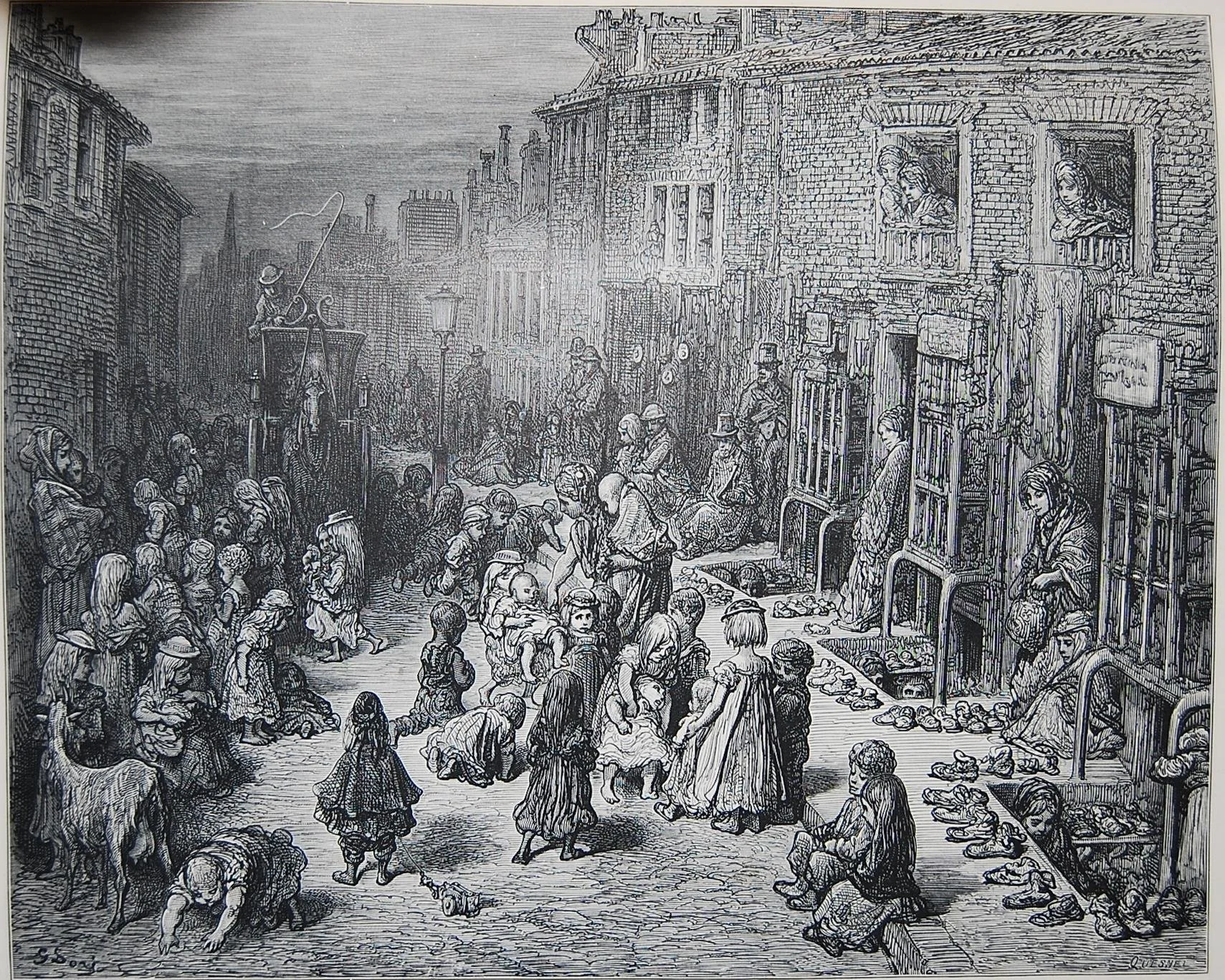
“Dudley Street, Seven Dials” wood engraving by Désiré Quesnel; illustrated by Gustave Doré in London: a Pilgrimage (1872) © The Trustees of the British Museum.
1.9 DRAWING THE THREADS TOGETHER
Across these domains, certain patterns recur: constrained incomes; insecure housing; limited, conditional relief; unequal access to health care; and layered forms of stigma. Women, children, the elderly, those living with illness or disability, and those outside respectable norms bore much of the weight.
This is the world in which George MacDonald lived and wrote. His fiction, while not documentary, consistently pays attention to the people who inhabit these structures: servants, laborers, widows, children, street drinkers, those in danger of the workhouse or asylum. When he brings biblical texts such as Isaiah 58 (true fasting and justice), Matthew 25 (Christ present in “the least of these”), and James (faith and works, partiality toward the rich) into his narratives, he does so in relation to these concrete social realities rather than in a purely abstract key.